Fortsatt betydelige finansieringsmuligheter for innovative energi- og industribedrifter

Til tross for budsjettkutt og endringer i deler av virkemiddelapparatet de siste årene, finnes det fortsatt betydelige finansieringsmuligheter for bedrifter som investerer i innovasjon, teknologiutvikling, omstilling og vekst. Dette var et av hovedbudskapene da Energy Valley deltok på Innovasjon Norges informasjonswebinar for næringshager, inkubatorer og klynger 19. juni.

– Mange bedrifter har fått inntrykk av at mulighetene er blitt vesentlig redusert. Bildet er mer nyansert. Flere av Innovasjon Norges viktigste ordninger har fortsatt betydelige tilgjengelige rammer, og det finnes gode muligheter for selskaper med sterke utviklingsprosjekter og ambisjoner om videre vekst, sier Knut Linnerud, EU-rådgiver i Energy Valley.

Flere sentrale ordninger har fortsatt sterke rammer

Under webinaret presenterte Innovasjon Norge status for en rekke finansieringsordninger og tilgjengelige midler gjennom 2026.

Blant ordningene som ble gjennomgått var:

  • Innovasjonslån
  • Grønt risikolån
  • Vekstlån
  • Vekstgaranti
  • Innovasjonskontrakter
  • Miljøteknologiordningen
  • Bioøkonomiordningen
  • Pilot-T
  • Oppstartstilskudd og oppstartslån
  • Markedslån
  • Sirkulære verdikjeder

Innovasjon Norge understreket at flere av disse ordningene fortsatt har betydelig kapasitet tilgjengelig for nye prosjekter, til tross for at enkelte programmer har fått reduserte rammer eller er blitt avviklet som følge av endringer i statsbudsjettet.

Særlig lån, garantier og flere av de målrettede innovasjonsordningene representerer fortsatt viktige finansieringsmuligheter for bedrifter som ønsker å utvikle ny teknologi, bygge nye markeder eller gjennomføre større investerings- og omstillingsprosjekter.

Relevante muligheter for Energy Valleys medlemmer

Mange av Energy Valleys medlemmer arbeider med utvikling og kommersialisering av ny teknologi innen energi, digitalisering, kunstig intelligens, industriell omstilling, havvind, hydrogen, CCS, energisystemer og andre fremtidsrettede næringer.

For disse bedriftene kan flere av Innovasjon Norges virkemidler være særlig relevante.

Miljøteknologiordningen kan bidra til utvikling og testing av innovative teknologier som løser vesentlige miljøutfordringer. Innovasjonskontrakter kan støtte samarbeid mellom teknologileverandører og pilotkunder. Innovasjonslån, vekstlån og risikolån kan bidra til finansiering av kommersialisering, oppskalering og internasjonalisering.

Ordninger knyttet til sirkulære verdikjeder, bioøkonomi og grønne investeringer kan også være aktuelle for bedrifter som arbeider med energiomstilling og utvikling av nye industrielle verdikjeder.

– Vi opplever at mange bedrifter har gode prosjekter, men at de ikke alltid kjenner til hvilke muligheter som finnes. Derfor er det viktig å synliggjøre at det fortsatt er betydelige midler tilgjengelig for selskaper som kan dokumentere innovasjonshøyde, markedsmuligheter og potensial for verdiskaping, sier Linnerud.

Energy Valley vil bidra til økt mobilisering

Som næringsklynge og medlemsorganisasjon arbeider Energy Valley aktivt med å koble bedrifter mot relevante finansieringskilder nasjonalt og internasjonalt.

Gjennom medlemsnettverk, webinarer og prosjektutviklingsaktiviteter bistår Energy Valley bedrifter med å identifisere aktuelle virkemidler fra Innovasjon Norge, Forskningsrådet og EU-programmer. Nettverk og samarbeidsarenaer knyttet til AI Energy Cluster kan også være relevante for bedrifter som ønsker å utvikle prosjekter med potensial for nasjonal finansiering, EU-finansiering og internasjonalisering.

Som EU-rådgiver har Knut Linnerud et særlig fokus på å hjelpe bedrifter med å bygge finansieringsløp som kan styrke konkurranseevnen og legge grunnlag for deltakelse i europeiske programmer og markeder.

Del av en større nasjonal satsing

Parallelt med dette arbeider Energy Valley sammen med GCE Ocean Technology og Energy Transition Norway med etableringen av Energy Cluster Norway (ECN), en nasjonal satsing som skal styrke samarbeid, innovasjon og verdiskaping på tvers av energisektoren.

Tilgang til relevante finansieringsordninger, økt mobilisering mot nasjonale virkemidler og sterkere deltakelse i europeiske programmer vil være viktige elementer i dette arbeidet

Ta kontakt

Energy Valley oppfordrer medlemsbedrifter som planlegger utviklings-, demonstrasjons-, pilot- eller kommersialiseringsprosjekter de neste årene til å ta kontakt for en uforpliktende samtale om aktuelle finansieringsmuligheter.

Har du et prosjekt du ønsker å diskutere?

Ta kontakt med Knut Linnerud, knut.linnerud@energyvalley.com Energy Valley for en innledende vurdering av nasjonale og internasjonale finansieringsmuligheter.

AI Energy Cluster: From Strategy to Implementation

Building a National Collaboration Platform for AI in Energy and Industry

Artificial Intelligence is rapidly moving from experimentation to implementation across the energy sector.

Over the past months, AI Energy Cluster has brought together companies, technology providers, research institutions, investors and public-sector stakeholders to explore how AI can create practical value across energy systems, industrial operations and critical infrastructure.

The strategy process recently culminated in a workshop hosted by Thommessen in Oslo, bringing together participants from across the energy, technology and innovation ecosystem.

A special thank you to Snorre Valdimarsson and the team at Thommessen for once again providing excellent facilities and hospitality. The venue provided an excellent setting for open discussions, knowledge sharing and collaboration.

We would also like to extend our sincere thanks to Eli Karine Navestad, Christopher Sparre-Enger Clausen and Bjørn Ravndal for sharing valuable insights and helping set the stage for the discussions.

Bjørn highlighted the growing importance of Operational AI and Predictive Maintenance, while Eli Karine and Christopher provided practical perspectives on Trusted AI, governance, cybersecurity, compliance and implementation challenges related to the EU AI Act and operational deployment.

The presentations are available upon request for those who would like to learn more.

Strengthening National Collaboration

As AI Energy Cluster moves into its next phase, Energy Valley is strengthening collaboration with both GCE Ocean Technology and Energy Transition Norway.

This collaboration is part of a broader effort to increase cooperation across the three clusters. The shared ambition is to establish Energy Cluster Norway as a common cluster organisation from 1 January 2027.

In this context, AI Energy Cluster is being developed as a concrete example of how the three environments can work together around shared strategic priorities.

Going forward, GCE Ocean Technology and Energy Transition Norway are expected to take a more active role in the initiative, both administratively and through mobilisation of their member companies.

Together, the three cluster environments represent a significant national network across:

  • energy,
  • offshore and maritime industries,
  • technology and digitalisation,
  • industrial operations,
  • research and innovation,
  • and critical infrastructure.

The objective is to develop AI Energy Cluster into a broader national collaboration platform for applied AI in energy, industry and critical infrastructure.

The challenge is no longer AI itself

One of the clearest messages emerging from both the strategy process and the workshop discussions was that the primary barriers are no longer technological.

Most organisations already recognise the potential of AI.

The key questions have become:

  • How do we implement AI in operational environments?
  • How do we move from pilot projects to industrial deployment?
  • How do we create measurable business value?
  • How do we establish trust in AI-driven decisions?
  • How do we manage governance, cybersecurity and compliance requirements?
  • How do we scale successful initiatives across organisations and value chains?

Across discussions, participants repeatedly highlighted that implementation, organisational readiness, data integration and change management often represent greater challenges than the AI technology itself.

Key themes emerging from the strategy process

Several priority areas consistently emerged throughout interviews, workshops, surveys and strategy discussions.

Predictive Maintenance & Asset Reliability

Strong interest was expressed around:

  • condition monitoring,
  • anomaly detection,
  • degradation modelling,
  • fatigue and corrosion monitoring,
  • vibration analysis,
  • performance optimisation,
  • and operational reliability.

Participants noted that many mature use cases already exist, but that scaling and operational adoption remain significant challenges

Trusted Operational AI

As AI moves closer to critical operations and decision-making, trust becomes increasingly important.

Topics discussed included:

  • explainability,
  • accountability,
  • governance,
  • cybersecurity,
  • regulatory compliance,
  • AI Act requirements,
  • and operational confidence.

Industrial Data Integration & Interoperability

A recurring observation was that many AI initiatives are constrained by fragmented data landscapes, legacy systems and limited interoperability.

Data contextualisation and integration were repeatedly identified as key enablers for future AI deployment

From Pilots to Scale

Several groups discussed the need to better define:

  • what constitutes a successful pilot,
  • how value should be measured,
  • when a solution is ready for operational deployment,
  • and how organisations can move from proof-of-concept to large-scale implementation.

Change Management & Business Value

Technology alone is rarely the limiting factor.

Successful implementation depends equally on:

  • organisational readiness,
  • stakeholder engagement,
  • business case development,
  • leadership commitment,
  • and demonstrating measurable value creation.

Building a collaborative platform

The strategy process has reinforced the need for a trusted arena where energy companies, technology providers, AI companies, research organisations, investors and end users can collaborate around shared challenges and opportunities.

The ambition of AI Energy Cluster is to support:

  • knowledge sharing,
  • project development,
  • pilot initiatives,
  • funding opportunities,
  • and collaboration across sectors and value chains.

Through closer cooperation with GCE Ocean Technology and Energy Transition Norway, the initiative will gain access to a broader national member base and stronger links across different parts of the Norwegian energy, offshore, maritime and technology ecosystem.

Help Shape the Next Phase

As we move from strategy towards implementation, we are inviting organisations across the ecosystem to help shape the next phase of AI Energy Cluster.

Over the past months we have gathered input through:

  • bilateral meetings and interviews,
  • the strategy survey conducted in May,
  • workshops and strategy discussions,
  • and written feedback received during the workshop on 18 June.

Several participants also asked whether they could submit additional reflections after the workshop.

To consolidate and update the input received so far, we have therefore launched a short follow-up survey.

Complete the survey here Click here to go to survey

The survey is intended to:

  • validate and prioritise focus areas,
  • identify potential working groups,
  • identify pilot opportunities,
  • identify project development initiatives,
  • and map interest in future collaboration activities.

If you already responded to the May survey or completed a paper form during the workshop, thank you. You are welcome to update, refine or expand your previous responses where relevant.

The survey is equally relevant for those who participated in the workshop and those who were unable to attend.

What Happens Next?

Input from the strategy process, workshop discussions and survey responses will now be used to:

  • refine priority focus areas,
  • identify pilot opportunities,
  • establish thematic working groups,
  • support project development,
  • explore relevant national and European funding opportunities,
  • and strengthen collaboration across regional and national innovation environments.

Together with GCE Ocean Technology and Energy Transition Norway, the ambition is to identify a small number of concrete collaboration tracks that can be developed further through AI Energy Cluster after the summer.

Potential activities include:

  • industry working groups,
  • pilot projects,
  • Joint Industry Projects,
  • national funding applications,
  • Horizon Europe and other EU opportunities,
  • and demonstration initiatives focused on operational deployment of AI in energy and industrial environments.

Whether your organisation is exploring AI, implementing AI solutions today, or looking for partners for future projects, we would be delighted to hear from you.

Together, we can help accelerate the responsible and value-driven adoption of AI across the Norwegian energy and industrial ecosystem.
Showcase your expertise at ONS

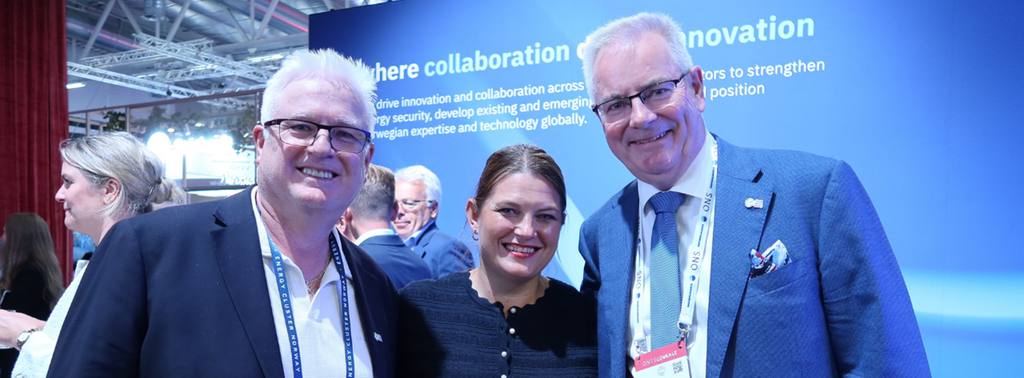
Through short, focused presentations, we will showcase technologies, solutions, knowledge and new ideas at our ONS stand.

We welcome our cluster to suggest presentations to be held at our stand at ONS before 30 May. Each presentation can be 15 minutes.

This invitation is open to members and partners that want to:

  • showcase new technology, products or services
  • present project experience and lessons learned
  • highlight new initiatives, collaboration or investment opportunities

Would you like to create a session?

We will organise the suggested presentations in sessions based on your input and suggestions. Joint cluster projects and small and medium sized companies will be prioritised.

You are also welcome to suggest longer sessions within a selected topic of your choice, featuring several presentations, with a total length of 30-90 minutes.  

The presentations will take place at the joint stand 9050 between Energy Transition Norway, Energy Valley and GCE Ocean Technology, beside the Centre Court in Hall 9.

Fill inn this form to suggest your presentation or session by 30 May.  

For more information contact jon.hellevang@gceocean.no  

About ONS

ONS is one of the world’s largest and most influential energy exhibitions and conferences. ONS gathers around 70 000 global industry leaders, policymakers, technology providers and innovators to address key challenges and opportunities across the energy and ocean industries. This year topic is “Courage”, addressing geopolitics, energy security and climate issues.

Energy Valley supports new incubator at Fornebu

Photo: RunwayFBU

Energy Valley is proud to be part of the new initiative to establish the first incubator at Fornebu. Through RunwayFBU, industrial AI startups and growth companies will gain direct access to industry partners, pilot environments and commercial scaling opportunities.

For Energy Valley, the initiative also represents a natural extension of the ongoing AI Energy Cluster work – where future collaboration projects, pilots and technology initiatives may evolve into new companies and spin-offs with international growth potential.

The incubator will connect industry with leading growth companies in industrial AI, with Energy Valley, Accenture, Telenor, Bærum Municipality and Akershus County Council on the owner side.

The incubator’s intention is to help technology companies move from promising ideas and pilot projects to real implementation and commercial scaling in industry.

Bridging the gap between technology and industry

Within Norwegian industry, we find some of the world’s most advanced technology environments, combined with increasingly complex operational challenges and a growing need for restructuring and digital transformation.

At the same time, many technology companies still struggle to move beyond pilot projects. The gap between technology development and industrial implementation remains too wide, particularly in complex B2B and infrastructure-heavy sectors such as energy, industry and critical infrastructure.

This is where RunwayFBU aims to make a difference.

The incubator has been accepted into the national incubation program of Innovation Norway (formerly Siva) and builds on the strong industrial and technology environment established at Aker Tech House at Fornebu.

A growth engine for industrial AI companies

The incubator is strategically situated in the middle of one of Norway’s strongest industrial and technology environments.

With strong industrial and public owners, companies connected to the incubator gain direct access to industry partners, operational environments, decision-makers and potential flagship customers.

This means access not only to capital and networks, but also to:

  • real industry challenges
  • operational data and pilot environments
  • industrial collaboration partners
  • structured support for moving from pilot to commercial agreement
  • expertise within scaling, industrialisation and commercialization

The ambition is clear: fewer pilots and more companies successfully operating in industry.

From AI Energy Cluster initiatives to scalable companies

Energy Valley’s AI Energy Cluster initiative is a strong strategic match to this environment.

Through webinars, workshops, strategy processes and project development activities, Energy Valley is building a pipeline of future AI and energy initiatives that may mature into pilots, startups and scalable industrial solutions.

As AI adoption accelerates across the energy system, there is increasing demand for environments that can help bridge the gap between innovation and implementation.

RunwayFBU may therefore become an important platform for further commercialisation, growth and international positioning of projects and companies emerging from AI Energy Cluster activities.

This is particularly relevant within:

  • industrial AI
  • energy optimisation
  • predictive maintenance
  • autonomous systems
  • digital infrastructure
  • cybersecurity and resilience
  • dual use technologies connecting civil and security-related applications

Strengthening international positioning and EU opportunities

The combination of industrial partners, AI competence and an emerging innovation ecosystem at Fornebu may also strengthen opportunities for participation in European innovation and funding programs.

This includes relevant opportunities connected to:

  • Horizon Europe
  • Digital Europe
  • European Defence Fund (EDF)
  • energy transition and industrial resilience initiatives
  • dual use and security-related innovation programs

For Energy Valley and its members, this creates opportunities not only for national collaboration and commercialization, but also for stronger international positioning and access to European innovation ecosystems.

Building a new innovation district at Fornebu

In addition to the public owners Akershus County Council and Bærum Municipality, RunwayFBU is initiated by strong industrial actors including Telenor, Accenture and Energy Valley.

The initiative brings together industry, technology companies and the public sector in one collaborative structure with a shared ambition:
to accelerate innovation, implementation and industrial growth.

The incubator is also an important step in the continued development of Fornebu as a leading Norwegian innovation district — where industry, startups, research environments and public actors work more closely together to solve real industrial challenges and develop scalable solutions faster.

For Energy Valley, being part of this environment strengthens our long-term focus on innovation, industrial collaboration and technology-driven energy transition.

At the same time, it provides Energy Valley members with access to a highly relevant ecosystem for industrial AI, commercialization, scaling and international collaboration.

Norway’s opportunity in industrial AI

Norway has a unique competitive position through world-leading industrial environments, high digital competence and strong experience within energy, offshore industries and advanced technology.

To maintain and strengthen this position, Norway must become better at transforming technology and competence into scalable companies and industrial implementation.

This is not only about developing new technology — but about getting solutions into use faster, at industrial scale and in international markets.

RunwayFBU is established to help solve exactly that challenge.

Do not hesitate to contact us for more information about the incubator at Fornebu.

Energy Valley Strengthens Its EU Engagement – Considering a Delegation Trip to Brussels

Energy Valley is actively working to strengthen our members’ access to European markets, funding opportunities, and strategic partnerships. As part of this effort, we are now exploring the possibility of mobilising a small delegation of member companies to Brussels from June 8–10, in collaboration with Energy Transition Norway (ETN).

The delegation will take place during the European Sustainable Energy Week (EUSEW) – one of Europe’s most important arenas for energy transition, technology and innovation. The programme combines insights into EU policy, funding opportunities and networking with key stakeholders in Brussels.

    Why is this relevant?

    The EU is currently investing heavily in:

    • energy transition
    • digitalisation and AI
    • industrial technologies
    • energy systems and flexibility
    • hydrogen and energy carriers
    • offshore wind
    • CCS/CCUS
    • cybersecurity and data infrastructure

    For many Norwegian companies, access to European networks and funding arenas will become increasingly important for future growth and innovation.

    Through the Brussels programme, participants will gain insights into:

    • Horizon Europe
    • Digital Europe
    • the Innovation Fund
    • the European Investment Bank (EIB)
    • the development towards the next EU framework programme (FP10)
    • how Norwegian companies can position themselves within European consortia and partnerships

    The programme also includes meetings and presentations involving representatives from:

    • the European Commission (DG ENER and DG DEFIS)
    • the Norwegian EU Delegation
    • the Research Council of Norway / NORCORE
    • Innovation Norway
    • the European Investment Bank (EIB)
    • European clusters and innovation networks
    • energy companies and industrial stakeholders

    Relevant for members with EU ambitions

    The delegation may be particularly relevant for companies that:

    • are considering Horizon Europe or Digital Europe participation
    • want to better understand EU funding mechanisms
    • are looking for European collaboration partners
    • work with AI, digitalisation or industrial technologies
    • develop solutions within energy, hydrogen, offshore wind or grid/flexibility
    • seek to position themselves towards European markets and consortia

    Participants are expected to cover their own travel and accommodation costs, while parts of the Brussels programme are hosted free of charge through ETN.

    The number of available places will be limited, and priority will be given to companies with clear strategic relevance and interest in EU-related activities.

    AI Energy Cluster and European Opportunities

    Energy Valley is also continuing the development of the AI Energy Cluster initiative, where European collaboration and EU funding are seen as key mechanisms for enabling larger industrial AI projects within energy and industry.

    The EU is currently investing significantly in:

    • AI infrastructure
    • industrial AI applications
    • data spaces
    • HPC and edge computing
    • cybersecurity
    • digital transformation of energy systems

    For companies interested in exploring this landscape further, the Brussels delegation may also serve as a valuable first step towards understanding how Norwegian stakeholders can connect with European initiatives and consortia.

    In parallel, Energy Valley is assessing the possibility of establishing a more targeted Brussels programme specifically focused on AI, energy and industrial digitalisation — potentially in collaboration with national and European partners.

    Looking for Support with EU Funding or Project Development?

    As part of Energy Valley’s EU engagement, we offer ongoing advisory support related to European programmes, partnerships and project development.

    We support members with:

    • identifying relevant EU programmes and calls
    • assessing project ideas and maturity
    • connecting with European partners and networks
    • consortium building and mobilisation
    • strategic discussions around EU positioning
    • connecting EU opportunities with national support schemes and innovation ecosystems

    Relevant programmes include:

    • Horizon Europe
    • Digital Europe
    • Innovation Fund
    • Connecting Europe Facility (CEF)
    • EIC Accelerator
    • Interreg
    • hydrogen and energy-related partnerships

    Energy Valley has already organised several activities related to EU funding and mobilisation within:

    • hydrogen
    • CCS/CCUS
    • energy carriers
    • offshore wind
    • AI and digitalisation

    We are seeing growing interest from member companies that want to:

    • develop European partnerships
    • participate in EU projects
    • better understand the European funding landscape
    • connect technology development with international market opportunities

    Please feel free to contact us for an informal discussion regarding:

    • relevant EU calls
    • EU strategy
    • project ideas
    • potential partners
    • the Brussels delegation
    • AI Energy Cluster
    • or other European opportunities relevant to your company.

    Contact:
    Knut Linnerud
    EU Advisor – Energy Valley
    knut.linnerud@energyvalley.com

    AI Energy Cluster – Moving from Strategy to Implementation

    Photo: Energy Valley

    Over the past months, AI Energy Cluster has brought together a growing ecosystem of companies, technology environments, researchers and public actors to explore how artificial intelligence can create practical value across the energy system.

    Following an extensive strategy and mobilisation process, the initiative is now moving into its next phase — from exploration and alignment toward more structured collaboration, pilot development and implementation.

    The strategy process has included:

    • workshops and roundtable discussions,
    • bilateral meetings and input sessions,
    • open webinars,
    • and the strategy and alignment session held on April 30.

    Across these activities, several common themes emerged consistently:

    • operational AI and predictive maintenance,
    • trusted and explainable AI,
    • industrial data integration and interoperability,
    • autonomous systems and robotics,
    • security, resilience and dual use,
    • and the challenge of moving from experimentation to scalable implementation.

    One of the clearest insights from the process so far is that the primary challenge is increasingly not access to AI models themselves, but rather the ability to combine AI with trusted operational context, industrial workflows, domain expertise and scalable execution.

    At the same time, many participants highlighted that the challenges facing the industry are largely shared across organisations and value chains — and that there is significant value in building trusted arenas for collaboration, knowledge-sharing and joint development.

    An updated strategy framework has therefore now been prepared for the next phase of AI Energy Cluster, focusing on four interconnected strategic areas:

    • Trusted Operational AI & Predictive Maintenance
    • Industrial Data Integration & Interoperability
    • Security, Resilience & Dual Use Energy Systems
    • Autonomous Systems, Robotics & Physical AI

    The strategy is intentionally designed to remain practical, flexible and execution-oriented, with emphasis on gradually maturing concrete initiatives, pilot tracks and funding opportunities rather than establishing heavy organisational structures too early.

    The next phase will focus on:

    • continued mobilisation and ecosystem building,
    • thematic workshops and collaboration arenas,
    • identification and prioritisation of high-value use cases,
    • pilot and project development,
    • and positioning towards national and European funding opportunities.

    Several related development tracks are also now being explored in parallel, including initiatives connected to:

    • AI, robotics and operational resilience in the energy sector,
    • dual use innovation and technology transfer,
    • cybersecurity and critical infrastructure,
    • and international collaboration opportunities linked to energy security and resilience.

    We have also recently received the first responses from the prioritisation survey distributed after the strategy process. The initial feedback confirms strong interest in collaborative activities related to operational AI, industrial implementation, interoperability, cybersecurity, autonomous systems and practical pilot development.

    The survey remains open, and we warmly encourage additional stakeholders to contribute:
    👉 https://forms.gle/XzXGvt9CtK9arFiK9

    The input will help shape:

    • upcoming workshops and thematic activities,
    • future collaboration tracks,
    • pilot and project priorities,
    • and potential funding and innovation initiatives moving forward.

    AI Energy Cluster is intended as an open and collaborative platform, and we welcome dialogue with companies, researchers, technology environments, public actors and organisations interested in contributing to the next phase.

    If you would like to:

    • participate in future workshops,
    • contribute use cases or expertise,
    • explore pilot opportunities,
    • discuss funding possibilities,
    • or engage in future collaboration activities,

    please feel free to reach out.

    The transition from AI experimentation to operational implementation across the energy system is still in an early phase — and the importance of trusted collaboration across sectors is becoming increasingly clear.

    We look forward to continuing the journey together.

    Recap from the 2025 Industry-Science Meetup

    Energy Valley CEO Bjørn Ottar Elseth sets the stage

    Energy Valley was proud to host its Industry-Science Meetup together with SINTEF and the University of Oslo.

    The half-day event offered short, engaging talks showcasing cutting-edge research, industrial technology projects, and successful partnerships between academia and business.

    Agenda

    13:30 Registration and mingling

    Welcome to Industry Science Meetup 2025

    UIO // Advanced biogas-to-methanol electrocatalysis by Petra Agota Szilagyi

    Wind Catching System // Developing Scalable Offshore Wind capacity by Daniel Engelhart-Willoch

    SINTEF // Fiber Optics in Geosciences by Marcin Duda

    DNV // Industrial AI: Assurance, Risks, and Opportunities for the Energy Sector by Carla Ferreira

    UIO // Hydrogen – New Challenges and Emerging Debates by Xi Yang

    15:30 Coffee & Mingling

    Hystar // Hypilot – Ultraefficient green hydrogen production by Eddy Van Oort

    SINTEF // Endpoint AI – some hardware-platforms to consider by Benedikt Andreas Mithassel

    UIO // Numerical and physical wave tanks by Atle Jensen

    17:00 Finish

    Did you miss the event? Take a look at some pictures from the day in our slideshow on LinkedIn!

    Tilskudd til forskning og innovasjon i bedrift

    Små og mellomstore bedrifter i Akershus kan nå søke om tilskudd for å bruke forskning i utviklingen av nye produkter og løsninger. Målet med ordningen er å styrke innovasjonsevnen og konkurransekraften i næringslivet gjennom støtte til forsknings- og innovasjonsprosjekter.

    Hvem kan søke?

    Ordningen er åpen for små og mellomstore bedrifter organisert som aksjeselskaper, samt foretak registrert i Enhetsregisteret som driver jordbruksproduksjon. Bedriften må ha lønnede ansatte både på søknadstidspunktet og i prosjektfasen, samt være registrert med forretningsadresse i Akershus.

    Hva kan dere få støtte til?

    Tilskuddet kan dekke inntil 50 % av de totale prosjektkostnadene for forsknings- og innovasjonsprosjekter. En forutsetning er samarbeid med en godkjent forskningsinstitusjon, og forskningen må utgjøre en nødvendig del av prosjektet. Dette må gjenspeiles i budsjettet.

    Hvor mye støtte kan dere få?

    Bedrifter kan søke om inntil 750 000 kroner per prosjekt. Prosjektperioden kan være opptil ett år. Totalt er det satt av 10 millioner kroner til ordningen i 2025.

    Viktige frister

    Det er to søknadsfrister i 2025: 2. mai og 1. november. Dersom det gjenstår midler, vil det være mulig å søke på nytt senere samme år.

    Hvordan søker dere?

    Søknad sendes via regionalforvaltning.no. Før dere søker, er det viktig å lese retningslinjene som gir utfyllende informasjon om søknadskriterier og vurderingsprosessen.

    Behandling og utbetaling

    Søknader behandles innen én til to måneder. Søkere som får innvilget tilskudd, må returnere akseptbrev og kan deretter be om utbetaling gjennom regionalforvaltning.no.

    Hvorfor deler Energy Valley denne informasjonen?

    Energy Valley arbeider for å styrke innovasjon og samarbeid i energisektoren. Dette tilskuddet gir bedrifter en unik mulighet til å finansiere forskningsbaserte utviklingsprosjekter, noe som er avgjørende for økt verdiskaping og konkurransekraft.

    EUIF Grants – Energy Valley x Innovayt

    One of the world’s largest funding opportunities for net-zero technologies is now open!

    The EU Innovation Fund’s (EUIF) current call offers €3.4 billion in total grants, following a €12 billion allocation to projects over the past 4 years. This call provides lump-sum grants that cover up to 60% of project costs, making it an excellent opportunity for innovative technologies to become Europe’s flagship projects aimed at significantly reducing emissions in the energy and industrial sectors.

    The EUIF supports key areas including innovative hydrogen production technologies, carbon capture and storage, renewable energy and energy storage. This commitment underscores its role in advancing diverse, essential energy technologies for Europe’s sustainable future, focusing on projects that have reached sufficient maturity. Furthermore, the fund has allocated a special budget of €1 billion for EV battery manufacturers to address Europe’s growing demand for electric vehicles. This substantial investment aims to spur innovation and competitiveness, positioning companies at the cutting edge of technology and strengthening their global market presence.

    Successful projects leverage the visibility and credibility gained from EUIF support to attract further investment and expand into new markets. Norwegian companies benefit from additional support provided by Enova, which assists with the application process and offers financial aid to cover related expenses. From the previous deadline, 8 Norwegian companies received EUIF support, highlighting Norway’s technology’s alignment with EUIF goals.

    The application deadline is 24 April, 2025. For companies interested in exploring this opportunity, Energy Valley is collaborating with Innovayt to provide guidance about the call and validate potential project matches. To set up a meeting and learn more, get in touch with Knut Linnerud on knut.linnerud@energyvalley.com.