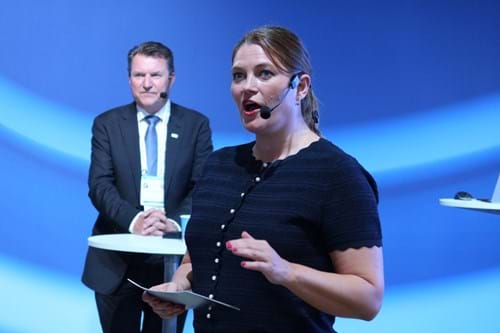
BalticSeaH2 podcasts are live!

The BalticSeaH2 project podcast is out! Why does hydrogen matter now, and what will decide whether it really scales?🎙️
The Hydrogen Valley Podcast is part of the BalticSeaH2 project and focuses on the conditions that shape the hydrogen economy in practice. The podcast looks at hydrogen beyond targets and announcements, with discussions on technology readiness, regulation, infrastructure, investments, and system-level choices that determine whether hydrogen can move from plans to implementation.
The first episodes answer questions like:
- Why are the opportunities for the hydrogen economy emerging now, and not ten years ago?
- What applications does hydrogen genuinely make sense for – and where does it not?
- Why do investment decisions take time?
The first four episodes are available now on Spotify and Apple Podcasts! Find more information and episode descriptions on BalticSeaH2 website.
Episode 1
Why has hydrogen been used for decades, yet the hydrogen economy is only now taking shape? 🎙️
Hydrogen has long been part of industrial processes, but its role in energy and industrial transition discussions has expanded significantly in recent years.
Episode 1 of the Hydrogen Valley Podcast focuses on what has changed around hydrogen. Not the molecule itself, but the surrounding system. Energy markets, policy frameworks, technology development, and industrial demand now intersect in ways that were not in place before.
The discussion looks at why hydrogen is increasingly considered at system level and what conditions need to be in place for it to scale beyond established industrial use.

🎧 Guests in this episode:
Mika Järvinen, Associate Professor from Aalto University discusses what makes hydrogen technically different from other energy carriers and why scale changes the challenge.
Simo Säynevirta, Head of H2 Springboard ecosystem at ABB, explains how low-cost renewable electricity has reshaped where hydrogen makes sense.
Samuel Cross, PhD, Coordinator of Aalto University Hydrogen Innovation Center, looks at why hydrogen now addresses sectors that cannot be electrified directly and why earlier cost barriers mattered.
The episode places hydrogen in its system context and focuses on conditions rather than promises.
Episode 2
Are hydrogen projects overhyped, or do large industrial investments simply take time? 🎙️
Hydrogen projects are often described as delayed or uncertain. Episode 2 widens the lens and questions whether hydrogen is being judged differently from other large industrial transitions.
Hydrogen is sometimes described as the champagne of the green transition. Useful in the right context, but not something you would use to wash windows. That question runs through the episode. Where does hydrogen actually make sense economically, and where does it not?
In Episode 2 of the Hydrogen Valley Podcast, the discussion focuses on regulation, incentives, and investment decisions, and on why timelines matter.

🎧 Guests in this episode:
Christian Langen, Executive in Residence at Aalto University, discusses why long investment timelines are a normal feature of major industrial projects, not a hydrogen-specific problem.
Janne Peljo, Chief Policy Adviser at EK – Finnish Confederation of Industries, explains how regulation and incentives shape investment decisions and why predictability matters more than speed.
Jan Feller, CEO of the German-Finnish Chamber of Commerce, looks at hydrogen from an investor and industry perspective and asks where hydrogen genuinely makes sense, and where simpler solutions might do. Sometimes choosing hydrogen everywhere is like reaching for champagne where water would do.
The episode highlights the importance of realism, clear use cases, and stable frameworks when building new industrial value chains.
Episode 3
Green hydrogen is expensive. What are the costly steps, and what actually helps bring the cost down? 🎙️
We have known how to produce hydrogen for over 100 years, but most production has relied on carbon intensive methods. Episode 3 of the Hydrogen Valley Podcast goes into the practical details of greener hydrogen production and why scaling matters.
The discussion looks at how green hydrogen is produced, where the bottlenecks typically sit, and what changes in production when capacity ramps up. It also touches on the trade offs involved in scaling, from technology choices to plant level realities.

🎧 Guests in this episode:
Tanja Kallio, Associate Professor at Aalto University, discusses how electrolysis works in practice, why water purity matters, and how different electrolyser technologies compare.
Tuomo Rinne, Vice President, Business Development at P2X Solutions Oy, explains what it takes to build and operate a green hydrogen plant and why site choices, offtake, and project timelines shape what is feasible.
Episode 4
Where should hydrogen flow, and how do infrastructure choices shape the hydrogen economy? 🎙️
Hydrogen infrastructure is planned decades ahead. Pipeline routes, transmission capacity, and grid reinforcements determine where production can emerge and where industrial demand can connect. Once built, these systems are difficult to rearrange, so expectations for the 2040s and 2050s already influence decisions made today.
Hydrogen differs from natural gas in volumetric energy density, which affects pipeline sizing and flow requirements. At the same time, green hydrogen production is electricity intensive. Renewable generation in Finland is concentrated in specific regions and increasingly volatile. Large electrolysers become major new consumption centres, linking hydrogen planning directly to electricity grid development.
Transmission pipelines, cross-border interconnections, permitting processes, and social acceptance all shape the pace and geography of hydrogen deployment. Infrastructure does not create markets on its own, but it defines what becomes possible.

🎧 Guests in this episode:
Esa Hallivuori, Senior Vice President at Gasgrid, discusses hydrogen transmission planning, national trunk lines, and cross-border pipeline development.
Janne Seppänen, Senior Expert in Strategic Grid Planning at Fingrid Oyj and Professor of Practice at Aalto University, explains how renewable expansion, grid stability, and hydrogen production must be aligned at system level.
Check out all the episodes:
🔗 You can find these and upcoming episodes on both Spotify and Apple Podcasts. As well as direct links from the BalticSeaH2 podcast page.
Other articles